
The problem
A growing set of self-hosted services needs more than spare CPU capacity. Storage dependencies, recovery paths and service placement matter just as much as how many guests fit on a host.
The approach
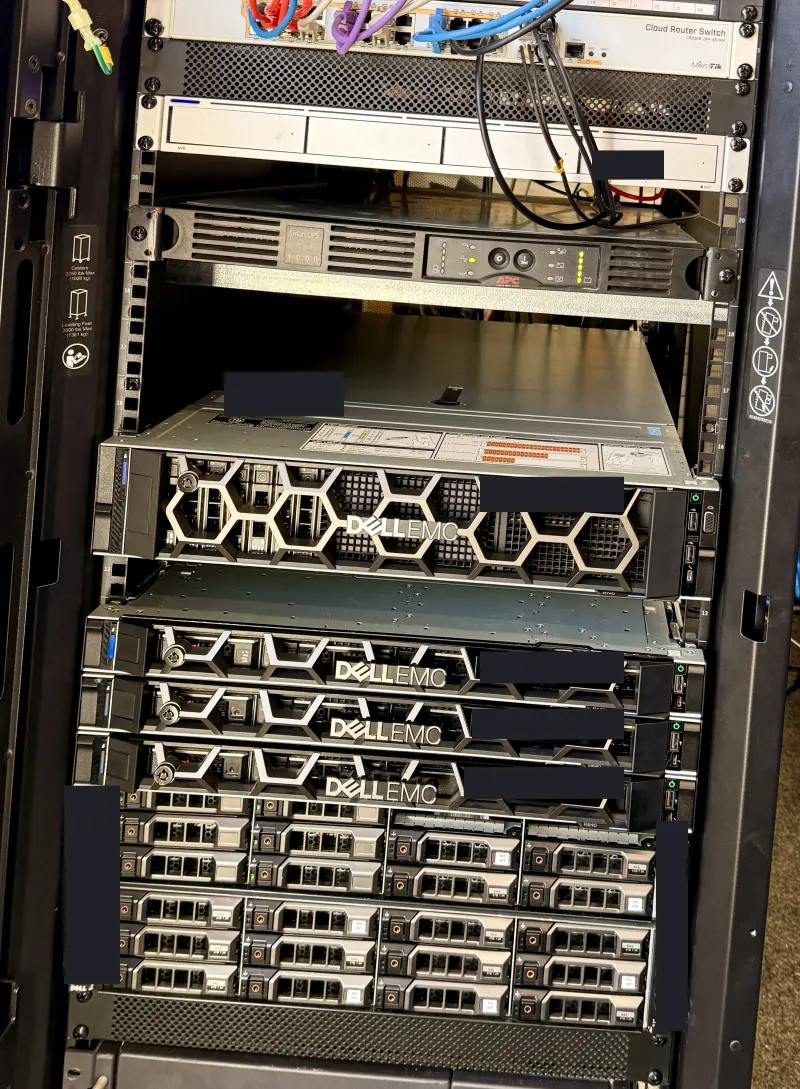
The lab uses Proxmox across six nodes. The main Dell fleet separates compute, application infrastructure, storage and public web hosting. The hardware is reused enterprise equipment, chosen for expansion and serviceability rather than silence. TrueNAS owns its storage through passed-through hardware. Application guests consume the storage services they need. Public hosting remains a separate static-serving role.
The trade-off
Virtualisation makes it easy to move a guest and surprisingly easy to overlook what it still depends on. A backup guest whose datastore lives on the same storage platform has a shared failure domain, even if its name says “backup”.
Where it stands
The 18 October 2026 inventory established the current platform and selected allocations. It was not a complete application-health, backup-coverage or disaster-recovery audit.
What I would repeat
Document the dependencies. Keep the source of a service separate from its serving directory. Test recovery as a workflow, not a reassuring green icon.